Greek Orthodox Easter
Cartes Postales from GreeceGreek Orthodox Easter is presented as a calendar that changes the ordinary rules of time, food, and public life. For Sylvie and Jean-Luc, unfamiliar with the difference between Orthodox and Catholic Easter, the festival first brings confusion and practical inconvenience; its ceremonies then unfold as a public sequence that Sylvie witnesses without initially understanding. The contrast between their outsider’s assumptions and the town’s shared observances makes the holiday both a religious occasion and a measure of how far they are from local life.
Dates and the Disruption of Ordinary Plans
Sylvie and Jean-Luc arrive believing Easter had already taken place in March. By the time they encounter the village’s preparations, it is nearly May. They had spoken to almost no one since arriving except a taciturn car-hire man, who had not explained the calendar difference or warned them that the holiday weekend carried an additional rental charge. Their error is not simply a mistaken date: it leaves them unprepared for a place whose public and commercial rhythms are being set by a religious calendar they do not know.
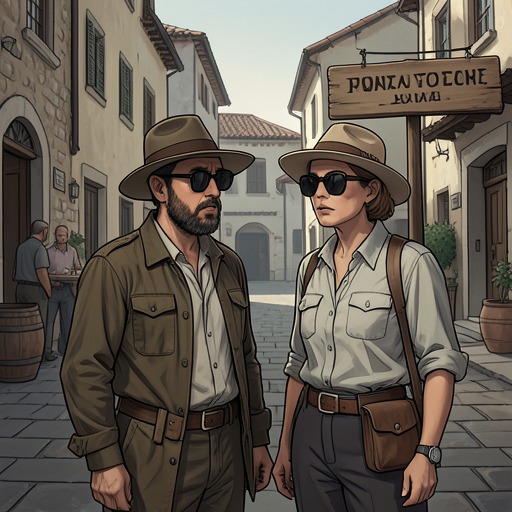
The mismatch becomes concrete when Jean-Luc takes Sylvie to a small taverna near the general store. Though every table appears empty, the owner asks whether they have booked. He tells them that a reservation is always necessary at Easter, especially on Good Friday. The couple can eat only until the epitafios has been carried through the streets and back to church; after that, the owner expects everyone to arrive. The empty room is therefore not evidence that the holiday is absent. It is a pause before the town’s communal observance and its participants return.
At the table, Jean-Luc says he would prefer meat, or at least decent fish, while Sylvie guesses that Lent is still in progress. She looks up Greek Orthodox Easter on her phone and reads the schedule as she understands it: the icon of Christ is carried around town that night, Judas is burned in effigy the next day, and Sunday celebrates Christ’s resurrection. Her account also identifies the food associated with each point in the sequence: seafood on Good Friday, a soup made from lamb’s entrails on Saturday, and lamb roasted on a spit on Sunday. Jean-Luc has no intention of staying for the Sunday meal. Their conversation brings the calendar into the immediate circumstances of travel, dinner, and how long they will remain.
Good Friday in the Streets
The procession Sylvie and Jean-Luc see is slower and more formal than an ordinary meal-time crowd. Four men carry a bier-like structure covered with thousands of white flowers, its frame also decorated with foliage. Clergy and altar boys follow, then a large band playing a funeral march; uniformed people, sailors, scouts, guides, and townspeople come behind them. Spectators throw petals into the road, and the procession sings a hymn as it passes. Sylvie recognizes the flower-covered object as the coffin she had seen in the church. The scene gives physical form to the observance the taverna owner has made the condition of their brief stay: the streets belong, for a time, to a solemn public ritual.
The procession also makes the couple’s partial understanding visible. Sylvie has gathered information from her phone, but knowledge of the sequence is not the same as familiarity with its practice. The owner’s limit on their meal, the slow passage through town, and the participation of clergy, civic groups, and residents place the observance around them as a collective event rather than a private explanation. The holiday is encountered through its effects on access, movement, and the use of public space.
Holy Saturday: Fire, Candles, and Recognition
On Saturday night, Sylvie remembers what she had read about the burning of Judas. Across the water, an island structure that first appeared as a dark silhouette is now blazing; in the flames, she can make out a scaffold and a hanging effigy. Fireworks and firecrackers erupt around her, making the moment resemble a battlefield. The Judas effigy thus appears not as a note in a schedule but as a striking, noisy spectacle, staged over the sea and watched from the shore.
At the same time, people nearby begin lighting candles. A flame passes from one person to the next until a thousand candles glow along the waterfront, where their light falls on faces from below. A woman puts a candle into Sylvie’s hand and lights it from her own. She greets Sylvie with the Greek Easter acclamation, “Christos Anesti!” and “Hronia Polla!” Sylvie does not understand what the words mean or know that the flame was brought from Jerusalem that afternoon. The scene sets her lack of comprehension against her physical inclusion: without understanding the greeting or the light’s significance, she nevertheless receives the candle and stands among the people celebrating Christ’s resurrection.
The crowd soon turns away to go to its meal, while Sylvie remains absorbed in the slow-burning effigy. Its lanky shape makes her think of Jean-Luc, and she recognizes that pain may be making her delirious. The episode keeps the festival’s communal brightness beside her private distress: a shared flame and a jubilant greeting do not erase the difficulty through which she is seeing them.
Annual Ritual and Sacred Time
The book’s account of Easter belongs to a wider pattern in which religious observances return according to an annual calendar and temporarily reorder communal life. A distinct January 6 observance, Theophany, offers a clear comparison, but it is not part of Easter. At the church, boys in orange brocade wait to carry a cross to the sea, while young men prepare to dive for it. The priest releases the cross into the water, and the swimmers compete to retrieve it; the winner receives a special blessing and becomes a local hero. The recurring ceremony draws church, town, and sea into a shared public event, just as the Easter procession and candlelit waterfront gather residents in the streets.
The comparison also clarifies how different these occasions are. Theophany centers on the retrieval of a cross from the water; the Easter scenes move from the Good Friday procession to the burning effigy and the light of the resurrection. In both, recurring religious time becomes visible through bodies, objects, and public participation. Easter’s calendar is not merely explained to Sylvie: it is encountered in a restricted meal, a town procession, an effigy above the water, and a candle passed from hand to hand.